The batteries moved from behind the cab to the middle of the chassis, the motor went inside the rear-axle housing, and system voltage climbed from 600 V to 800 V. Those three things happening together means the whole design logic was rewritten. Understand them and the spec sheet starts to make sense.
A diesel heavy truck carries a row of fuel tanks behind the cab. An electric truck replaces that volume with battery packs — but the most radical approach puts the packs entirely between the chassis rails, the so-called underfloor layout.
Three benefits. First, the centre of gravity drops and body roll under load falls noticeably. Second, the space behind the cab is freed for a larger trailer — SANY's SE636 uses underfloor packs to reach 240 m³ of cargo volume without losing payload. Third, the packs are protected by the frame rails, which is better in a rear-end or side impact.
The cost is serviceability: when an underfloor pack fails, the truck goes on a lift and the whole pack comes out, which is far more labour than a rear-mounted layout. That is also why many port fleets prefer swap models — a bad pack is simply exchanged and the truck stays in service.
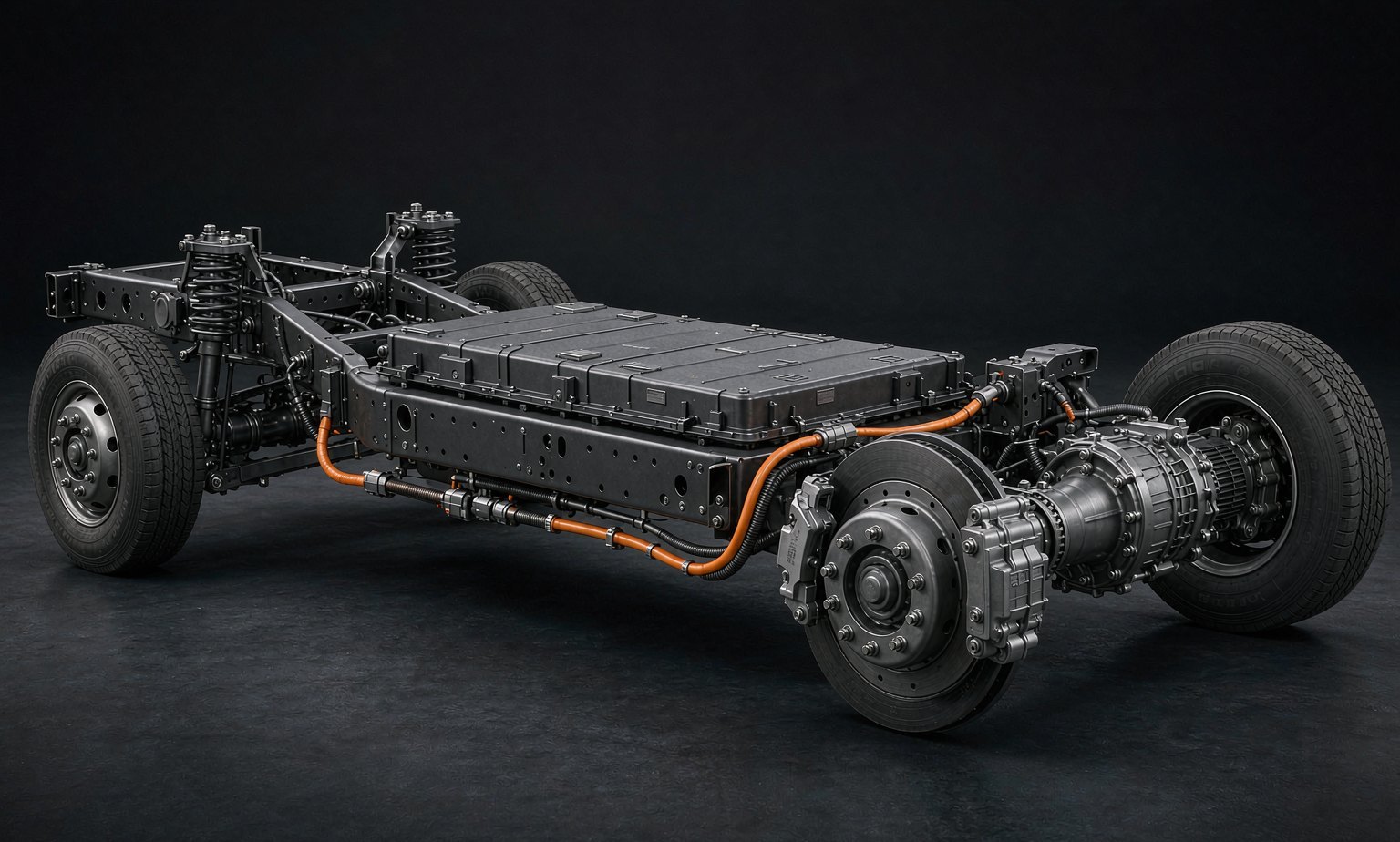
A diesel driveline runs engine – gearbox – prop shaft – rear axle. An electric truck compresses the first three into the axle.
The earliest approach: keep the diesel axle and swap the engine for a motor. Cheap to convert, but 5–8% of driveline efficiency is lost and the weight does not come down. Mostly found on early type-approved models and conversions.
Motor, reduction gear and differential in one unit, prop shaft deleted. Driveline efficiency rises above 94% and the freed chassis space takes batteries. Now standard on mainstream models and the hallmark of a dedicated EV platform.
The long-haul approach, as on the SANY SE636: two motors, each with its own gearbox, a tall ratio for gradeability at low speed and a short one for efficiency at cruise. If one set fails, torque does not drop to zero.
At the same power, doubling voltage halves current. Halving current means thinner cables and less heat; indirectly it means charging power can be much higher — the SANY SE636 uses 800 V with 1000 A over four guns to add 300 km of range in 30 minutes, roughly a third more efficient than a 600 V platform.
800 V is not free: SiC devices, insulation ratings and charger compatibility all have to be redone. That is why only long-haul models adopt it; short-haul trucks stay at 600 V because they refuel by swapping or by overnight slow charging, and fast-charging capability would go unused.
Passenger cars chase energy density; commercial vehicles chase cycle life. A heavy truck covering 150,000 km a year for eight years runs 1.2 million km, which means more than 3,000 full cycles. On that dimension lithium iron phosphate beats NMC decisively, and it also has a higher thermal runaway threshold and tolerates abuse better.
The price is cold-weather performance and energy density. That is why electric trucks lose far more range in a northern winter than in the south — it is chemistry, not a manufacturer overstating its numbers.
Illustrative values for comparison; real range varies by up to ±25% with temperature, gradient and driving style
This is not an argument about which technology is better. It is an argument about asset structure, and choosing wrong costs more than the price difference between trucks.
| Dimension | Charging (fast) | Battery swap |
|---|---|---|
| Refuel time | About 60 minutes for 600 kWh on twin guns | 3–6 minutes |
| Purchase cost | Battery included: $96.8k–$111.7k | Battery separated: glider $44.7k–$67k plus monthly battery rent |
| Infrastructure | ~5,000 truck charging sites and 84,000 dedicated chargers nationwide — broad coverage | ~1,200 swap stations nationwide, heavily concentrated in ports, mining areas and steel mills |
| Suitable routes | Any route where a charger can be found | Must be a fixed closed loop with a station along it |
| Battery life risk | Owner carries the degradation | Operator manages the packs; the owner does not carry degradation risk |
| Asset flexibility | High — the truck can be resold or reassigned at any time | Low — locked to a swap network, expensive to exit |
| Current market share | About 70% | About 30% |
The claimed figure is an ideal-condition number. Real range = battery × usable SOC ÷ actual consumption. Change the three inputs below and watch the difference.
Reference consumption: 1.1–1.3 on flat ground at standard load, 1.6–1.9 heavy in mountains, plus 20–30% in winter. Usable SOC usually keeps a 10% reserve to avoid deep discharge.
High-power fast charging heats the pack hard, and liquid cooling is what handles it. Cheap direct-cooling designs degrade quickly under frequent fast charging, and after two or three years their range falls faster than competitors'. Ask which one you are buying.
If insulation fails after a crash on an 800 V platform, the rescue risk is far higher than on a 12 V system. Reputable manufacturers trigger an immediate high-voltage cut-off from the crash signal and fit pack pressure-relief valves. Confirm both are present.
Powertrain faults on an electric truck can only be handled inside the authorised network; a roadside shop cannot touch them. Service radius, parts depot locations and response times belong in the same comparison table as price and range.