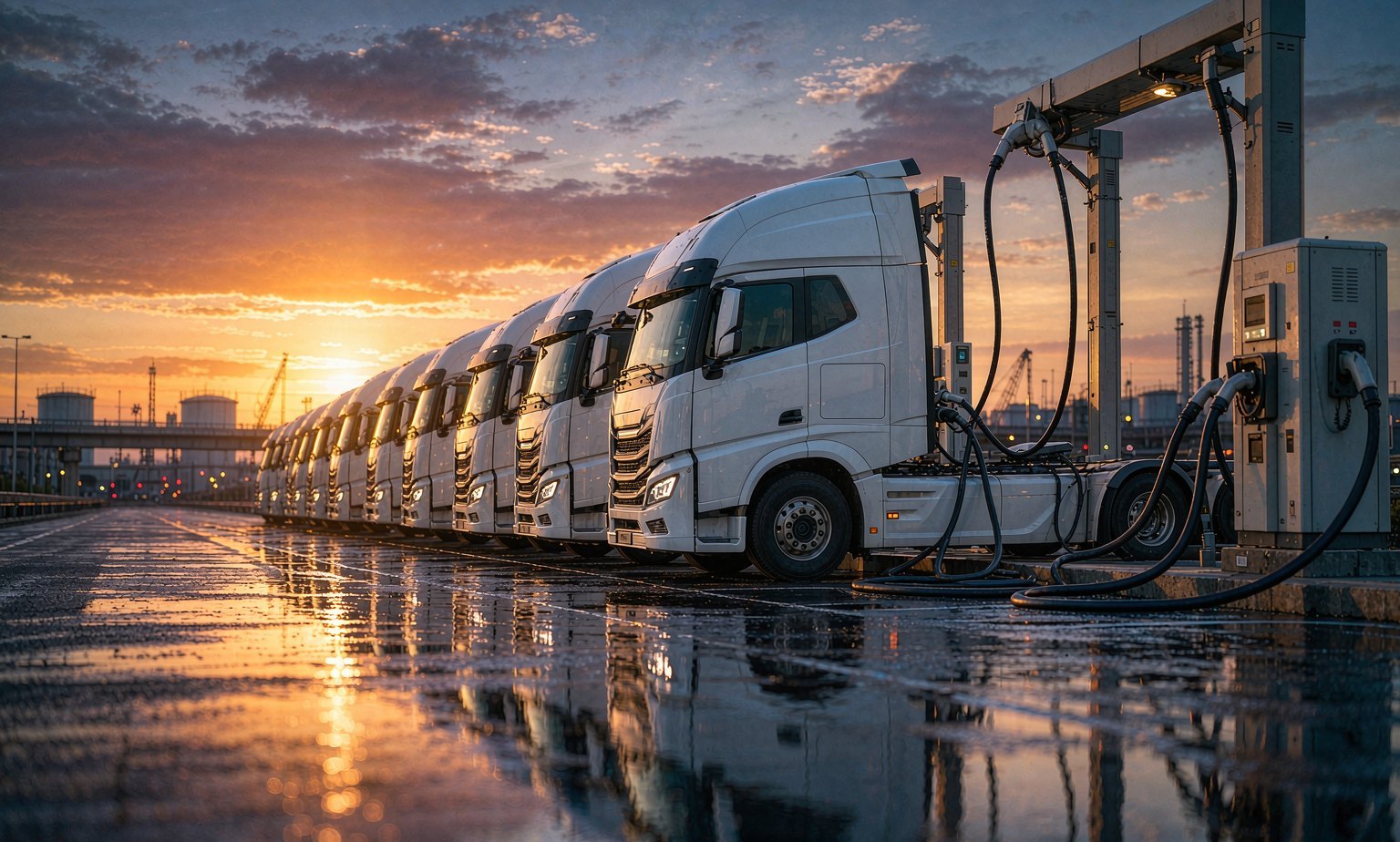
A fleet of battery-electric heavy trucks charging at a highway fast-charging hub
Industry research · New-energy commercial vehicles

Electric heavy trucks:
the freight system being rebuilt now

China put 231,100 new-energy heavy trucks on the road in 2025, nearly three times the year before; by May 2026 the monthly penetration rate passed 40%. Yet worldwide, a full year of exports would still not fill one mid-sized steel mill's fleet. This is an industry that is at once euphoric and infant.

10 major manufacturers 33 models on sale, fully specced Specs · prices · duty cycles
231,100 units2025 domestic sales
+182%Year on year
40.9%May 2026 monthly penetration
92.9%Top-10 combined share
Industry electrification rate (2025)
20.5%
Up 11.3 points year on year
Top-5 combined share
70.0%
The leaderboard has largely set
Battery installations
96.7GWh
+188.9% YoY, LFP accounts for 99%
Heavy-truck swap stations (China)
1,200sites
Plus ~5,000 charging sites and 84,000 dedicated chargers
01 / Competitive landscape

The leaders are not truck giants — they are two construction-equipment players

XCMG and SANY together hold 29.9% of the market, and they did it without highway dealerships. They came with the mining and port customers they had supplied since the excavator era — fixed routes, room for a swap station, no sensitivity to range. Those are the only places where an electric heavy truck already closes its business case.

#Company2025 sales ShareYoYProfile
1XCMG 35,400
15.3%
+147%King of worksites
2SANY 33,600
14.6%
+138%Sells and services direct
3FAW Jiefang 32,400
14.0%
+241%Fastest of the big three
4Sinotruk 27,300
11.8%
+249%King of overseas KD
5Shacman 26,200
11.3%
+280%Strong in coal
6Foton 18,900
8.2%
+299%Dark horse
7Dongfeng Trucks 18,300
7.9%
DoubledMost watched
8Farizon 11,300
4.9%
DoubledMethanol + BEV
9Yutong Trucks 6,155
2.7%
+4%Only staller
10JAC 4,587
2.0%
+94%Regional logistics
2025 market share
Compulsory-insurance retail registrations · excludes exports

Source: First Commercial Vehicle Network / compulsory-insurance retail registrations

Three caveats when reading this table. First, these are retail registrations (compulsory insurance); the operating-licence basis gives 195,600 units and a slightly different order, so do not mix the two when citing. Second, sales leadership is not product leadership — XCMG and SANY dominate closed sites, while open highway freight still belongs to Jiefang, Dongfeng and Sinotruk. Third, Yutong is the only top-10 player with essentially flat growth, while United Truck outside the top 10 grew 695% in 2025. Next year's ranking will likely change hands.
02 / Price map

Prices are not one line — they are three parallel lines

Of the 33 models on sale, 26 carry a public list price. Spread them by price band and three almost non-overlapping groups appear: short-haul with small packs, 600 kWh trunk tractors, and swap or special-spec worksite trucks. Prices are converted from CNY at 1 USD = 6.71 CNY.

The 26 models with a public list price, by band
Unit: models

Under $75k: short haul, small packs, the fastest payback

5 models, 281–528 kWh, 190–430 km claimed. Most are built for port shuttles, on-site transfer and fixed loops around a city, and this is where the price war is ugliest: XCMG Hanvan XG2 at 400.6 kWh for $70k, Dongfeng Kinland KL at 400 kWh for $72.4k. One outlier — the Sinotruk Sitrak G7M at 528 kWh and 430 km claimed for $73.9k — is the most range per dollar in the band.

$75k–90k: the mainstream 400–600 kWh middle

7 models, and the widest spread: 234 kWh on the Shacman Delong New M3000 up to 600.9 kWh on the XCMG Hanvan XG2. Pricing here has stabilised; rivals of the same capacity sit within $5k–10k of each other and compete on drivetrain efficiency, consumption and service coverage. In this band, price sensitivity should give way to cost per kilometre and the distance to the nearest service point.

$90k–105k: 600 kWh trunk tractors and the newer 400 kWh platforms

6 models in two groups. The 600 kWh long-haul tractors — Sinotruk HOWO TX EV at $102.8k and Dongfeng Kinland KL at $99.8k with 460 km claimed — and a cluster of 400 kWh platforms whose price comes from the cab, electronics and swap hardware rather than the pack: Foton Auman iBlue Starwing at $98.1k, HOWO TX EV Swap at $98.3k, Farizon X7E at $103.1k and the XCMG Hanvan E7 at $104.3k.

Over $105k: long-haul tractors, swap worksite trucks, one record-holder

8 models, and the group that breaks any simple rule. Long-haul tractors at 600 kWh and up (XCMG Hanvan E7 600 kWh at $107.3k), reinforced swap trucks and construction dumpers (Shacman M3000E Swap at $114k, Foton EST Swap at $128.1k) — expensive because of frame, axle and swap-hardware strength, not because of the battery. And the SANY Mota 1165 at $295k, a 1165 kWh tractor with 810 km of measured range that is really a different product class.

A counter-intuitive fact: more kWh does not mean a higher unit price. Going from 400.6 to 600.9 kWh on the XCMG Hanvan XG2 costs just $19.4k more, about $97 per kWh; some 280 kWh swap models work out above $402 per kWh. Buying the bigger pack is often the cheaper way to buy capacity.
03 / Selected models

One model per brand, to set the frame

These six are each brand's representative configuration. Open one for the full spec table, street price and selection notes. All 33 live in the model library.

Open the full model library (33) →
04 / Three duty cycles

Who is actually paying for these trucks

The duty cycle decides the model, the battery size and the refuelling method — and whether the maths works at all.

Electric heavy trucks at a container terminal
Ports and container terminals: fixed routes, short legs, swap-ready — the most mature electric use case

Ports and steel mills: the first beachhead

A 5–30 km one-way leg, two shifts around the clock, a route that never varies. Those three features neutralise the two weaknesses of an electric truck — short range and slow refuelling — at the same time. The swap station sits beside the yard, the driver changes packs in five minutes and keeps moving, and the truck and the battery can be financed separately.

It is also why XCMG and SANY reached the top: they were already the equipment suppliers to these ports and mines in the construction-machinery era, so the customer relationships, on-site service and parts depots were already there.

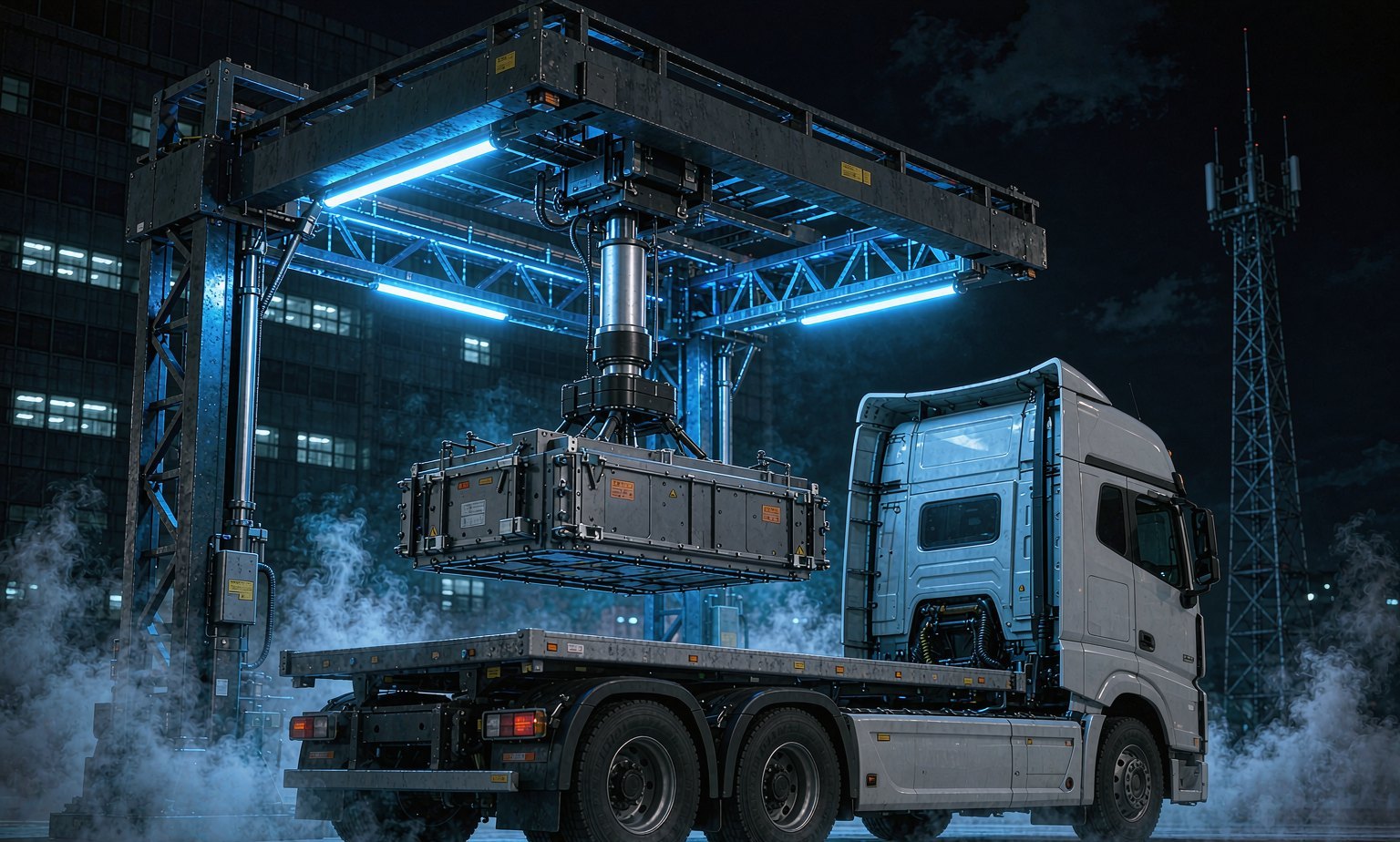
Battery swap station for electric heavy trucks operating at night
Swap stations: a five-minute refill, but heavy capex and hard lock-in — only for high-frequency fixed routes

Charging or swapping: not a technology argument, an asset-structure argument

Swapping strips the battery off the truck and cuts the purchase price by $29.8k–$59.6k. The price is that you must commit to one swap network and pay battery rent every month. China's 1,200 swap stations sound like a lot, but they are extremely concentrated — leave those few hubs and the capability is worthless.

Charging is cheaper and freer, but filling 600 kWh takes an hour or more, so it only suits shifts where the truck rests while the driver does. Today the split between charging and swapping is roughly 7:3; charging is still the mainstream.

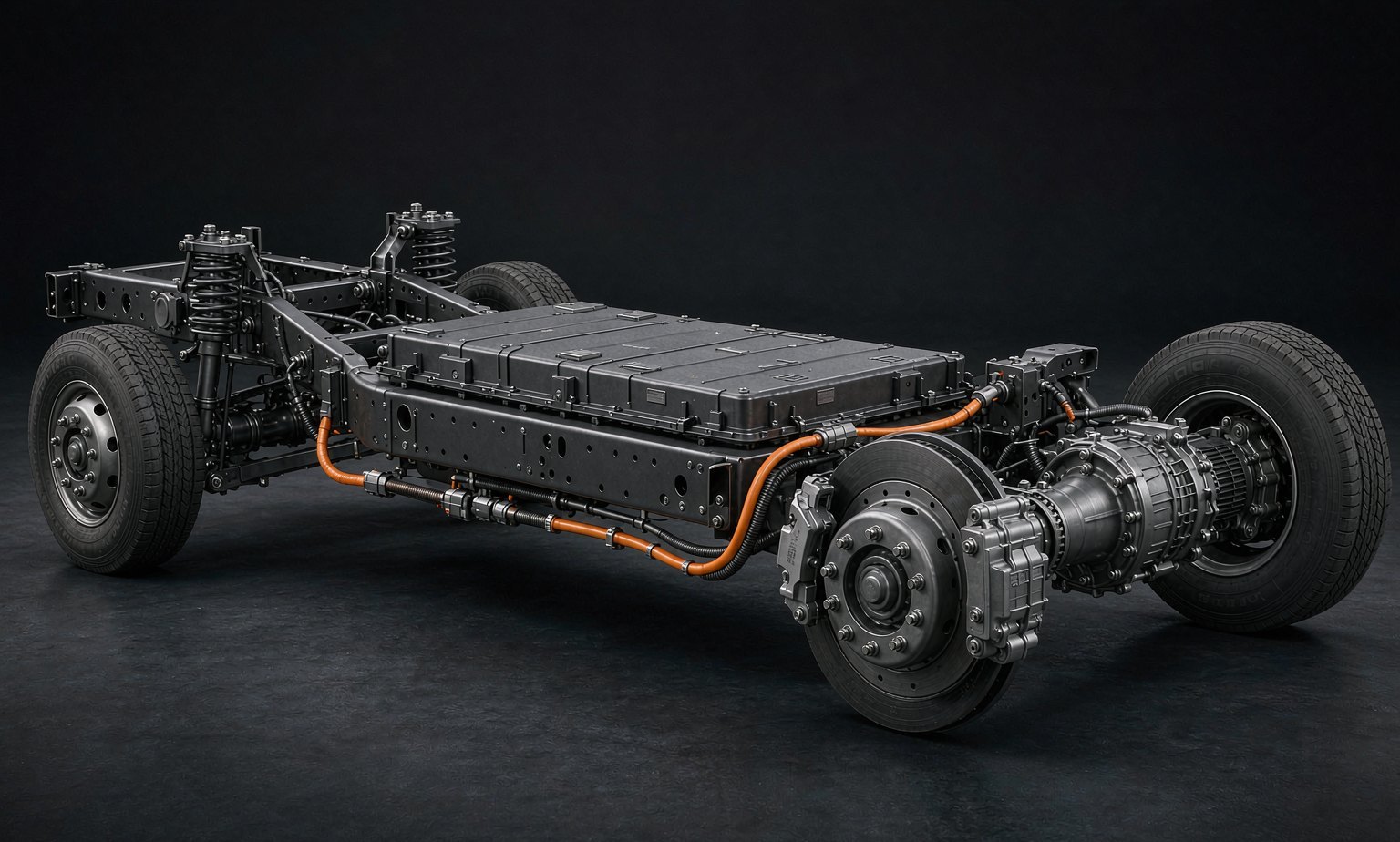
Electric heavy truck chassis with underfloor battery packs and an e-axle
Underfloor batteries plus an e-axle: structurally, an electric truck is no longer a diesel truck

The powertrain is the real dividing line

An electric heavy truck is not a diesel truck with a different motor. Underfloor packs lower the centre of gravity, an e-axle folds motor, reduction and differential into one housing, and an 800 V architecture cuts charging to 30 minutes — together these rewrite the whole design logic of the vehicle.

99% of the market uses lithium iron phosphate. It is not the best on energy density, but its cycle life and safety suit a commercial vehicle that charges twice a day and covers a million kilometres in eight years.

Continue to the technology column →

05 / Contents

What else is in this column